skip to main |
skip to sidebar
 Remember the Leeds Supertram fiasco
How ten years of planning and financial arranging all got pissed against the wall last year by HM Government ?
How the people of the City of Leeds were royally shafted and told that our plans for a nice, clean, green public transit system were crap, after being told how good they were for ten years ?
How, for the sake of £500million, a good percentage of which would be raised via private investment, this fourth largest city in England would have to stick to filthy unsafe buses that may or may not turn up in accordance with the rough guess that is the "timetable" ?
Well, the small print of that incredible Dept of Transport ineptitude was that they would research "some viable alternatives" for the city and get back to us.
And true to their word they've done their research and they've got back to us - with £1.7million and some red paint.
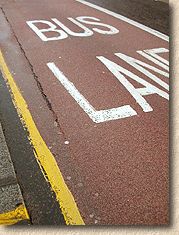
The viable alternative to an integrated city-wide electric tram system (like many cities in the UK already have) is to paint a bus lane down one of the major routes into Leeds and use the existing filthy, unsafe buses on them.
Burley Road (A65) is one of several major routes into Leeds, its two lanes wide in both directions and it clogs with traffic for a couple of hours every morning and every evening. It already had various sections of it as dedicated bus lanes so that the car traffic can effectively already only use one lane at peak times whilst the dedicated bus lane stands empty most of the time waiting for the next bus, which may or may not come along depending on how pissed off the driver is that day.
Notice how I mention that the A65 already has a bus lane for most of its distance ?
Thats because its true.
So the new viable option (which will cost £3million in total) is to have, erm, well, a bus lane.
"But you've already got one" I hear you all cry.
Yes its true I reply, but you see the old bus lane is a black and white one, that is the bus lane markers are white paint ont he black road surface - the new bus lane is going to be painted red, so, well, it different - now come on, thats thinking out of the box there isn't it, how did we not think of that one years ago, why did we think we needed £500m spending on supertram when all along we could have had inventive red bus lanes to do the same job for a fraction of the cost - how stupid we were.
Thats it, thats what we're getting, a bus lane where a bus lane already exists, its just a colour bus lane instead.
And another thing ...
Note how I use the word "unsafe" when referring to the old dirty buses ?
Its because a friend of mine has a 14 year old son who was travelling into Leeds with two friends at 5pm one evening a short while ago when they were mugged by three older boys with three mobile phones and a quantity of cash take - the bus did not have video and the driver was not interested when the boys told him, in fact he put them off the bus at the next stop.
The friend of mine is actually a police officer and attacks and muggings on buses as well as disinterested drivers are apparently not uncommon.
Its why I don't let my girls ride on Leeds buses - they are not safe.
The red bus lanes will be nice though.
 Yesterdays return to work by many city dwelling office workers saw their first new shock of 2007 - train fares increased across the board.
Our train operators in the UK are all private companies delivering a public service on behalf of HM Government who abdicated their responsibility to provide a public transport service many years ago - but still like to keep at least one finger in the pie.
The train operators have two levels of price increases - those lines which are deemed by HM Government to be "regulated" services, ie the routes that commuters use most regularly, and the "unregulated" lines, ie everything else.
Regulated routes are allowed by Government decree to have a 1% above inflation increase every year in order to encourage investment in the rolling stock and service to customers whilst showing some sort of restraint on price increases. Unregulated routes are a free for all with every operator applying whatever increases they think they can get away with.
The 4.3% rises on regulated routes and up to 7.3% increases on some other lines don't really affect me at all, I have a car and use it always in preference to public transport, HM Government has not yet invented a reliable, safe, clean method of transporting me where I need to be at any time of the day that will surpass my car and the last time I used a train was around 15 years ago - the last time I used a bus was...I can't remember when the last time I used a bus was.
Now you may remember that back in April last year I tried to book a journey by train from Newcastle to Leeds and failed dismally to even find out how much it would cost me, let alone when the bloody train would run, eventually with the online help of someone who knows about trains and things I managed to get quotes from two operators who gave me eight different, completely different prices for a single ticket on exactly the same train, eight people sitting in the same carriage could have paid a fare ranging from £11 to £80 depending on whether they had a friend like mine who knows about trains, or not.
Confusion on tickets and their pricing is just one issue though - the real big one is that HM Government desires that we desist from using our cars for journeys and instead use public transport, trains being one of the favoured forms of public transport - unfortunately the train operators would prefer it if not so many of us would use their services.
Its a well known and well publicised fact that many train routes at certain times of the day are now specially targetted for special extortion by the operator simply because too many people want to use them - most obviously these are commuter routes at the start and end of the day when most people are travelling to and from work - the demand for services at these times of day are well documented to cause serious overcrowding on trains with most commuters having to stand in carriages for most, if not all of their route - and still pay the same price as those lucky enough to get a seat, an inflated price at that - I've said it before many times, if you invented a train carriage now you'd never get the idea past the Health and Safety Executive :-
"So you have 300 seats on your train, how many have seat belts ?"
"None of them sir, I don't think they'll need seat belts"
"Oh dear, erm, well we do actually"
"Well if we promise not to stop quickly will it be ok ?"
"We'll take it into consideration, erm, what is this scheme here for allowing another 500 people to stand on your train ?"
"Well theres loads of room in the aisles when all the seats are taken and I thought, well maybe we could squash a lot more in if they stood up"
"Do we really think that this is safe, hmmm ?"
"It will be if they're really crammed in properly, they'll cushion each other when we crash"
"I think you need to think this through again Mr Stephenson"
The obvious answer to anyone who gives the topic just two seconds of thought is "if the route is so popular that is causes massive overcrowding, then why not put more carriages on the train ?", too simple a solution ? Put it in a supermarket context - a demand is created for Birds Custard that means that it sells out as soon as the tins are put on the shelves, what do the supermarkets do - do they put the price up to £20 a tin so that no-one buys it any more, or do they just make room on their shelves to stock more of the product - I'll leave you to come to the obvious conclusion.
So there we have it - a Government who would love us to all save the planet and transfer our allegences to public transport versus transport operators who can't figure out a solution on how to handle the current level of demand let alone the Government desired increases and who are allowed (with the sanction of Government) to increase fares year on year to discourage public transport usage.
I am not mad.
 Yet another report is issued today recommending that the government introduce taxation on road usage as soon as possible as a way to tackle congestion.
This current report seems to blindly follow the mantra that if you charge a lot of money for people to use the roads that they travel on, then they simply won't use them anymore and the roads will be less congested - its primary school economics, nice and simple so that politicians can understand it.
But it fails to address so many issues.
It fails to address the fact that we already have a method of taxation on road usage, its called the road tax, its that little round disc that you find on the front of (most) cars that can cost up to £175 a year - simple solution number one - increase the road tax disc to £500 a year to achieve the same effect as road charging but at a hugely significant lower cost, in fact with no additional cost at all.
It fails to address the fact that the revenue from the road tax disc is swallowed up into the treasury coffers and barely none of it is reinvested back into transport issues, the money raised from road usage or road tax should be ringfenced for a number of years until we have viable alternatives to using your own car quite so often - it won't be though, not with the cost of guided bombs being so ludicrously high and our army firing them off in Iraq and Afghanistan like they've got bottomless pockets.
It fails to address the fact that when this Labour Government was elected it made a commitment to getting people out of their cars and onto public transport and it encouraged many local authorities to invest ratepayers money into planning applications and preparatory work for grandiose public rapid transit systems, at the very least this Labour Government, led by the then Transport Secretary John Prescott , planned to have such a tram or train system in every major city in the UK by now.
Since then they have systematically rejected almost every one of those applications for government funding, shifting the goalposts every time so that the local authority applications wouldn't qualify for central funding for a new inventive reason so that nine years later we are no further forward, there is simply no reliable alternative for most people than to use their cars to go to the places that they want to go to - and there are no plans to make this situation any better in the near future.
We should have known all along that it was too good to be true after the time that John Prescott had a huge press photo-call at a London railway station showing how committed to rail travel he was and how everyone else should follow his example as he travelled north to his constituency. Photos taken, interviews given, the train set off only for Prescott to get off at the next stop where his ministerial car was waiting to take him the rest of his journey - unfortunately for Prescott he didn't realise that some of the press and photographers had got on the train with him and the headlines the next day were hilarious.
Its not enough to simply tax people off the road, you have to provide some alternative to personal transport usage otherwise many local economies will simply collapse - things aren't like they were 30 years ago and many people simply have to travel some distances to work and to shop.
Take Leeds as an example.
Leeds is a city built on a cartwheel design, it just happened that way by accident but the city is almost like a perfect cartwheel with all of the major routes into the city being the cartwheel spokes, the outer ring road around the city being the wheel itself and the inner ring road being the actual wheel hub.
Leeds City Council already have in place some of the expensive equipment that will eventually be used to introduce road charging and we can see that the plan is obviously to introduce road charging on all of the major "spokes" into the city centre and also within the circle of the city centre that is the inner ring road.
What this plan fails to address is that there are numerous other minor routes into the city which people will simply use instead, moving the congestion off the major routes onto housing estate rat runs. It also fails to realise that when travelling from anywhere north of the city to get to the M1 motorway (which is south of the city), you simply have to go through the centre, there is no other way to get there other than a 45 minute trip right around the often single carriageway outer ring road.
The plan also fails to understand that unlike many other major city's Leeds does not have a huge out of town shopping mall but has instead spent millions on regenerating its victorian/edwardian centre to the extent where the city centre shopping experience in Leeds is actually a tourist attraction now and earns the city millions in revenue every weekend - charge for driving into the centre and you lose the attraction when people can simply drive to malls and shop and park for free.
The plan also fails to understand that by far the biggest use of private vehicle usage is for getting to and from work and whilst a lot of people work in the city centre who would benefit from a better public transport system, by far the biggest number of people work outside of the outer ring road on the industrial estates which ring our city - they were placed there to keep industry out of the centre (quite sensibly) but there is no public transport provision that uses the outer ring road route, you cannot use a public bus to take you around the city you have to catch one bus into the centre then another out to your destination - its quite ridiculous.
And finally the plan also fails to take into account shift workers - there is simply no public transport available for early morning, late evening or night shift workers, up to a third of all employees are simply not even thought of by our public transport policies.
There is more to congestion charging than just raising tax to pay for more bombs Gordon.


